

The Marketing Strategy Dilemma in 2026
Let’s be honest, most businesses don’t struggle with doing marketing. They struggle with choosing the right kind of marketing.
You’ve probably been there. One expert tells you to “run ads and scale fast.” Another insists “SEO and branding are the real game.” And somewhere in between, you’re trying to figure out where your money actually brings results.
If you’ve spoken to a Digital Marketing Agency Chennai, chances are this debate has already come up. And it’s not a small decision.
Put everything into performance marketing, and you might see quick wins, but feel the pressure to keep spending. Focus only on brand marketing, and you might build something strong, but wonder why leads are slow in the beginning.
So what’s the right move?
That depends on one thing most businesses overlook, your stage of growth and what your business actually needs right now.
This blog isn’t about choosing sides. It’s about helping you understand when to build your brand, when to push for conversions, and how to make both work together without wasting budget.
2. What is Brand Marketing in Digital Marketing?
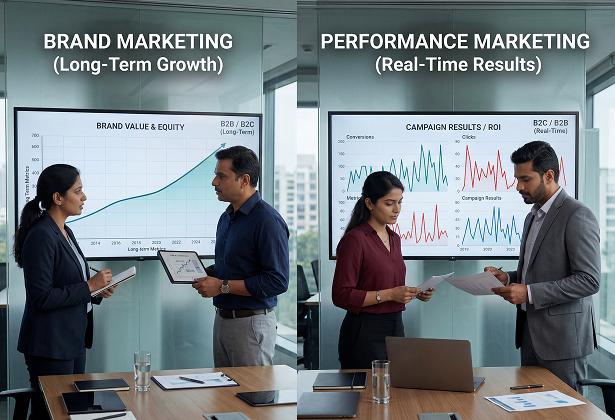
Brand marketing focuses on building awareness, trust, and emotional connection with your audience. It’s not about immediate conversions, it’s about long-term perception.
Key Elements:
Core Objective:
To make your brand the first choice in the customer’s mind before they even search.
In B2B, brand marketing positions you as an authority. In B2C, it creates emotional recall.
3. What is Performance Marketing?
Performance marketing is conversion-driven marketing, where every rupee spent is tied to a measurable outcome, clicks, leads, or sales.
Key Channels:
Core Objective:
To drive immediate, trackable results.
Unlike brand marketing, performance marketing operates on precision, targeting the right audience at the right time with the right message.
Brand Marketing vs Performance Marketing: Core Differences
| Factor | Brand Marketing | Performance Marketing |
|---|---|---|
| Focus | Awareness & trust | Leads & conversions |
| Timeline | Long-term | Short-term |
| Measurement | Indirect (recall, engagement) | Direct (ROI, CPL) |
| Strategy | Emotional & narrative | Data-driven & tactical |
| Sustainability | High | Depends on spend |
5. Reason #1: Long-Term Equity vs Short-Term Conversions
Brand marketing builds equity that compounds over time. It ensures that when customers are ready to buy, your brand is already trusted.
Performance marketing, on the other hand, drives instant conversions. It’s effective, but only as long as you keep spending.
Strategic Insight:
- Brand marketing = Investment
- Performance marketing = Expense
6. Reason #2: Emotional Connection vs Data-Driven Targeting
Brand marketing taps into emotions, values, and storytelling. It builds loyalty.
Performance marketing relies on analytics, targeting, and optimization. It drives action.
Example:
- A B2C fashion brand uses storytelling to build aspiration
- The same brand uses ads to convert interest into sales
7. Reason #3: Customer Journey Influence in B2B vs B2C
B2B Buying Behavior:
- Longer decision cycles
- Multiple stakeholders
- Research-driven
Brand marketing plays a critical role in trust-building.
B2C Buying Behavior:
- Shorter cycles
- Emotion-driven decisions
- Instant gratification
Performance marketing drives faster conversions.
8. Reason #4: Cost Efficiency Over Time
Performance marketing can become expensive as competition increases.
SEO and brand-driven content reduce dependency on ads, lowering acquisition costs over time.
Key Insight:
Businesses that invest only in performance marketing often face rising CAC (Customer Acquisition Cost).
9. Reason #5: Scalability and Market Positioning
Performance marketing scales with budget.
Brand marketing scales with authority and perception.
The strongest brands dominate not because they spend more, but because they are remembered more.
10. What Works Best for B2B Businesses?
For B2B businesses, brand marketing is non-negotiable.
Why?
Best Approach:
11. What Works Best for B2C Businesses?
For B2C, performance marketing often leads the strategy.
Why?
Best Approach:
12. The Hybrid Strategy: Why Integration Wins in 2026
Top-performing brands don’t choose, they integrate.
Hybrid Framework:
Phase 1: Performance Marketing
- aGenerate traffic and validate offers
Phase 2: Brand Marketing
- aBuild authority and trust
Phase 3: Retargeting
- aConvert and nurture leads
Outcome:
13. The Role of Brand Consultants in Scaling Growth
At a certain stage, businesses hit a plateau, not because of lack of marketing, but because of lack of brand clarity.
This is where brand consultants become critical.
By leveraging Expert Brand Growth Solutions, businesses can:
Without this layer, performance marketing becomes inefficient, and brand marketing becomes inconsistent.
14. Future Trends: AI, AEO & Full-Funnel Marketing
The marketing landscape is evolving rapidly.
Key Trends:
What This Means:
15. Final Takeaway: Choosing the Right Strategy for Your Business
Here’s the strategic breakdown:
• Want immediate results? → Performance Marketing
• Want long-term growth? → Brand Marketing
• Want market dominance? → Combine both
The Smart Play:
Start with performance marketing for traction, build brand marketing for sustainability, and integrate both for scale.
16. FAQs
No. Both serve different purposes, brand marketing builds trust, performance marketing drives conversions.
Brand marketing is more cost-effective in the long run, while performance marketing delivers quicker results.
Yes. Even small businesses can build strong brands through consistent messaging and content.
Yes. B2B buyers rely heavily on trust and authority before making decisions.
Absolutely. A hybrid approach delivers the best results in 2026.