

Google has officially started phasing out FAQ rich results from Search, marking a major shift in how websites earn visibility on SERPs.
For years, SEO teams relied on FAQ schema to occupy more search real estate, improve click-through rates, and target additional keyword variations.
But as search evolves into an AI-driven ecosystem, Google is now prioritizing cleaner SERPs and more helpful search experiences over excessive rich result clutter.
Businesses working with a modern SEO and digital growth partner must now rethink how content is structured for both traditional search and AI-powered discovery.
As of May 7, Google officially announced that FAQ rich results will no longer appear in Search for most websites.
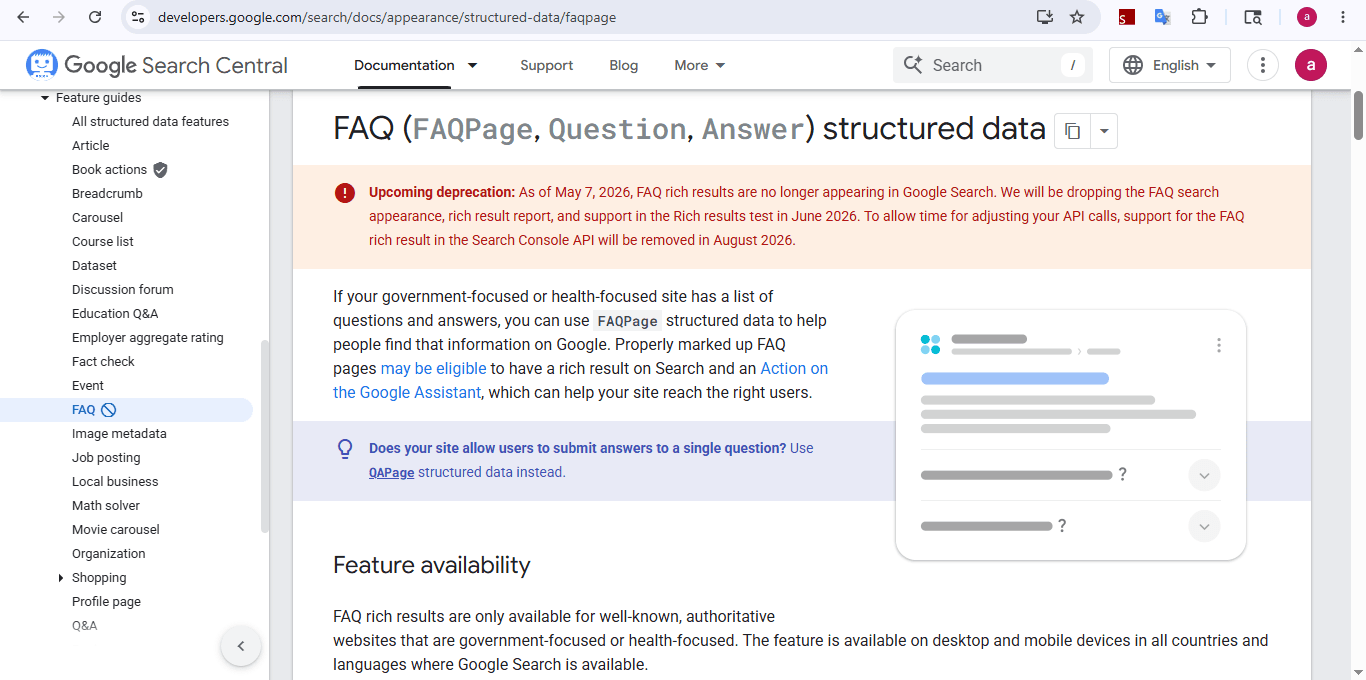
Shortly after, Google Search Console will retire FAQ reporting, the Rich Results Test will remove FAQ support in June, and API support will disappear in August.
This is not just a technical SEO update. It signals a larger change in how Google wants content creators to think about user intent, SERP optimization, and structured content.
What Exactly Did Google Announce?
Google confirmed that FAQ rich results are being deprecated across Search. This means pages using FAQPage structured data will no longer receive the expandable FAQ snippets that previously appeared below search listings.
The update impacts:
Google’s reasoning is simple: FAQ rich results became heavily overused and often manipulated for keyword visibility rather than genuine user support.
Over time, the search experience became crowded with repetitive FAQ sections offering little real value.
Why Google Is Removing FAQ Rich Results
FAQ schema started as a helpful enhancement. It allowed websites to directly answer user questions within search results. But eventually, many websites turned FAQs into an SEO loophole.
Common misuse included:
Google’s systems evolved enough to identify these patterns. As a result, the search engine decided that widespread FAQ rich snippets no longer improved search quality.
This aligns with Google’s broader shift toward:
The update is less about removing FAQs and more about removing manipulative SERP tactics.
The Rise and Fall of FAQ Schema in SEO
When FAQ schema gained traction, it became one of the easiest wins in SEO.
Websites could:
For a period, almost every service page, blog, and landing page included FAQs, whether they were necessary or not.
But this mass adoption diluted the quality of FAQ content.
Instead of helping users, FAQs became another keyword placement zone.
That ultimately triggered Google’s rollback.
How This Update Impacts Organic CTR and SERP Visibility
Many websites will likely see changes in click-through rates after losing FAQ rich snippets.
Previously, FAQ rich results helped listings:
Now, those advantages disappear.
This means SEO strategies that depended heavily on structured FAQ visibility may experience reduced SERP dominance.
However, this does not mean traffic will collapse.
Websites with genuinely valuable content, strong authority signals, and optimized user intent alignment will continue performing well.
In fact, this update may actually benefit high-quality publishers because low-value SERP clutter is being reduced.
Should You Remove FAQ Schema From Your Website?
The answer depends on your broader content strategy.
Google has clarified that websites can either:
That’s important.
While Google may no longer display FAQ rich snippets prominently, other systems still utilize structured Q&A formatting.
This includes:
Removing FAQ schema completely may not be strategically necessary.
FAQs Still Matter in 2026
Many SEOs are misunderstanding this update.
Google deprecated FAQ rich results, not FAQs themselves.
Well-structured FAQs still play a critical role in content optimization.
User Experience and Information Clarity
Good FAQs improve usability. They help users:
For example, businesses investing in enterprise SEO services often use FAQs to answer highly specific implementation, reporting, and technical questions that users naturally search for.
That directly improves page usefulness.
AI Search and LLM Optimization
Large Language Models prefer structured and conversational content.
Q&A formats are easier for AI systems to process because they:
This creates opportunities for:
FAQs may no longer dominate traditional SERPs, but they remain valuable in AI-driven search ecosystems.
Voice Search Relevance
Voice search still depends heavily on conversational content structures. Users ask questions naturally. FAQ formats mirror that behavior.
Well-written Q&A sections increase the chances of voice-based answer retrieval.
Alternative Search Engines Still Use FAQ Schema
Not every search platform follows Google’s exact roadmap. Some search engines and AI platforms still leverage FAQ structured data for enhanced results.
That means FAQs continue providing cross-channel discoverability benefits.
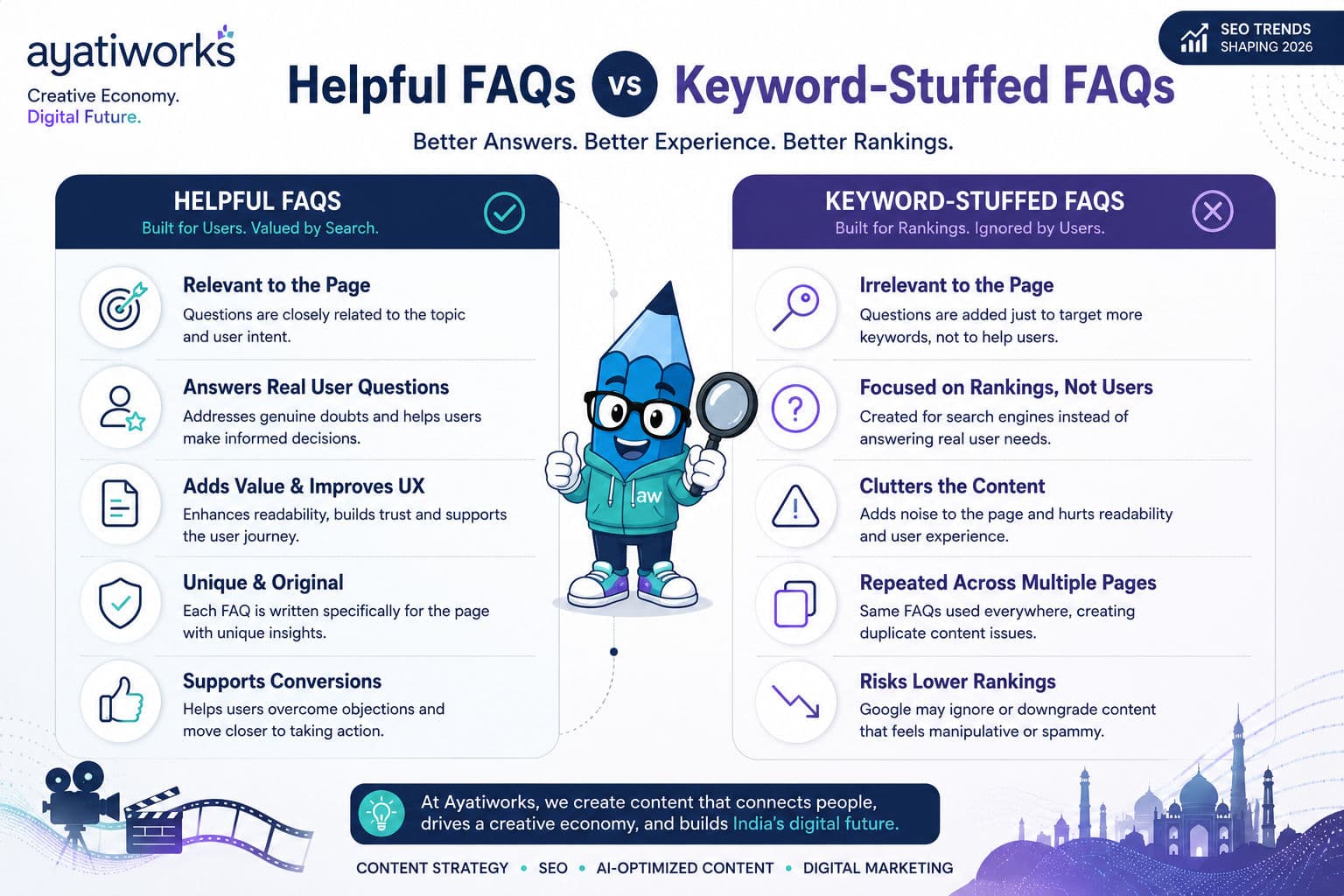
Helpful FAQs vs Keyword-Stuffed FAQs
This update forces content creators to rethink how FAQs are written. The difference between useful FAQs and manipulative FAQs is now extremely important.
How to Use FAQs Correctly in 2026
The role of FAQs has changed. They are now a content experience element rather than a SERP manipulation tactic.
Prioritize Relevance
Every FAQ must directly support the core topic of the page. If the page discusses SEO audits, the FAQ should answer audit-related concerns — not random keyword variations.
Contextual Placement
FAQs should be placed where they provide the most value to the user, often after the main content to answer final objections or technical details.
Unique Questions Only
One of the biggest SEO mistakes is reusing the same FAQ blocks sitewide. This creates content redundancy and weakens topical uniqueness. Instead, tailor FAQs specifically to page intent.
Intent-Based Formatting
Structure FAQs for humans first. Write naturally. Avoid robotic formatting designed only for search engines. Good FAQs feel conversational, direct, and useful.
FAQs should help users complete their information journey. That means answering:
For brands investing in content marketing and SEO strategy services, FAQs now function more as conversion-support assets rather than traffic hacks.
What SEOs Should Focus on Instead of FAQ Rich Results
This update shifts focus towards broader visibility strategies.
E-E-A-T Signals
Google increasingly rewards:
Thin FAQ-heavy pages without credibility will continue losing visibility.
AI-Optimized Content Structures
Search is moving toward AI-generated summaries and answer engines. Content must now be:
Entity SEO
Focus on becoming a recognized entity in your niche. Build topical clusters and ensure your brand is semantically linked to key industry topics.
Conversational Search Optimization
Modern search behavior is becoming more natural language driven. Instead of isolated keywords, content should answer broader conversational intent.
Featured Snippet Strategies
While FAQ rich results disappear, featured snippets remain valuable. Clear formatting, concise answers, and strong topical coverage can still secure high-visibility SERP positions.
FAQ Content and the Future of AI Search
This update is not the death of FAQs. It is the death of FAQ abuse.
AI-driven search ecosystems still rely heavily on:
As AI Overviews and answer engines expand, structured informational content becomes even more important. The difference is that quality now matters significantly more than quantity.
How LLMs Still Use Q&A Content Structures
Large Language Models are trained on massive corpora that include Q&A formatted content. When generating answers, LLMs actively prefer content that is clearly structured as questions and answers, contextually relevant, authoritative, and conversational in tone.
SEO Strategies to Replace Lost FAQ CTR Opportunities
With FAQ rich results disappearing, SEO teams need alternative strategies to maintain click-through rates, such as optimizing for featured snippets, strengthening title tags, and focusing on AI overview visibility.
Common Mistakes Brands Will Make After This Update
Many websites will react incorrectly. Some will remove all FAQs unnecessarily, stop answering user questions, or ignore AI search optimization. That would be a mistake. The smarter approach is to evolve FAQ implementation rather than abandon it entirely.
Final Thoughts: FAQs Are Evolving, Not Dying
Google removing FAQ rich results marks the end of a specific SEO tactic — not the end of FAQs as a content strategy.
FAQs still matter for user experience, AI visibility, voice search, intent completion, conversion support, and semantic relevance.
The websites that adapt successfully will be those that stop treating FAQs as ranking shortcuts and start using them as meaningful informational assets.
Search in 2026 is no longer about maximizing SERP tricks. It’s about building genuinely useful, context-rich content ecosystems that both users and AI systems trust.
Frequently Asked Questions
No. Google is only removing FAQ rich results from Search appearance. Websites can still use FAQs on pages where they genuinely help users understand a topic, service, or process better.
Not necessarily. FAQ schema can still support AI search systems, voice search, and alternative search engines. If your FAQs are relevant and useful, keeping the markup may still provide long-term value.
Google found that many websites were overusing FAQ schema for keyword stuffing and SERP manipulation rather than helping users. The update is part of Google’s broader push toward helpful, high-quality content experiences.
Yes. FAQs still play an important role in SEO, AI search visibility, and user experience. Well-structured FAQ sections help users and AI systems quickly identify contextual answers related to search intent, services, pricing, implementation, usability, and decision-making. While Google may no longer prioritize FAQ rich snippets, FAQs continue to provide semantic relevance, conversational context, and structured Q&A content that AI-driven search platforms and LLMs prefer for answer extraction and citations.
Content creators should focus on E-E-A-T signals, AI-optimized content structures, conversational search intent, topical authority, and creating genuinely useful informational content that improves user trust and engagement.
Need help adapting your SEO strategy for 2026?
Talk to Our SEO Experts