

Why SEO Feels Broken in 2026: But It Isn’t
Aren’t we hearing a lot of this off late...
SEO is a TRAP
SEO is DEAD
SEO isn’t working
Most businesses are skeptical to take on SEO for their business, since they aren’t aware of it, neither are they getting the right agency or people to execute what they want.
Again, it is very clear that search engine optimization has changed faster than ever before. Many businesses that invested in SEO earlier now feel frustrated because the same techniques are not giving the same results.
Rankings drop without warning; traffic becomes inconsistent, and content that once ranked well suddenly disappears from search results.
This has led to a common belief that SEO no longer works, when the real problem is that search engines have evolved.
Google’s algorithm updates, AI-driven search results, helpful content guidelines, and stronger quality checks have completely changed how websites rank.
Strategies that worked five years ago may not work today, and businesses that continue to follow outdated methods often struggle to see growth. This is why working with an experienced digital marketing agency in Chennai becomes important, especially when SEO requires a structured approach based on current ranking factors instead of old practices.
Another reason for the confusion is that SEO today is not just about keywords or backlinks.
Search engines now evaluate user intent, content quality, website experience, authority, and consistency.
Companies that adapt to these changes continue to grow, while those that rely on old tactics assume SEO has stopped working.
To understand the difference, we need to look at what still works in modern SEO and what no longer helps websites rank.
The strategies that succeed in 2026 are very different from the ones businesses used in the past.
Why SEO Is Not Working for Many Businesses in 2026
If SEO feels harder today than it did a few years ago, it is not because SEO stopped working. It is because the way search engines evaluate websites has changed.
Many businesses are still following old optimization methods while Google is ranking pages based on relevance, experience, authority, and user intent.
When the strategy does not match the current algorithm, rankings drop even if the effort is high.
One of the most common reasons SEO fails is that companies focus on activity instead of strategy.
Publishing blogs regularly, adding keywords everywhere, or building random backlinks does not guarantee rankings anymore.
In fact, these practices can sometimes make performance worse. Many of the problems businesses face today are the same SEO mistakes businesses make when they try to follow outdated advice without understanding how modern search works.
Another major issue is ignoring search intent.
In 2026, Google is not just matching keywords, it is matching meaning. If a page does not clearly answer what the user is looking for, it will not rank, no matter how many times the keyword appears.
This is why websites with fewer pages but better content often perform better than sites that publish large amounts of low-quality articles.
Technical quality also plays a bigger role now. Slow websites, poor mobile experience, broken internal links, and unstructured content can reduce rankings even when the content itself is good.
Search engines want to recommend pages that users can trust and navigate easily, not just pages that contain keywords.
Consistency is another factor many businesses underestimate. SEO today is not about quick results.
It requires planning, structured content, proper linking, and regular updates.
Companies that treat SEO as a one-time task often believe it is not working, while those who follow a long-term approach continue to see steady growth.
To understand what actually works now, it is important to separate proven SEO strategies from methods that are no longer effective.
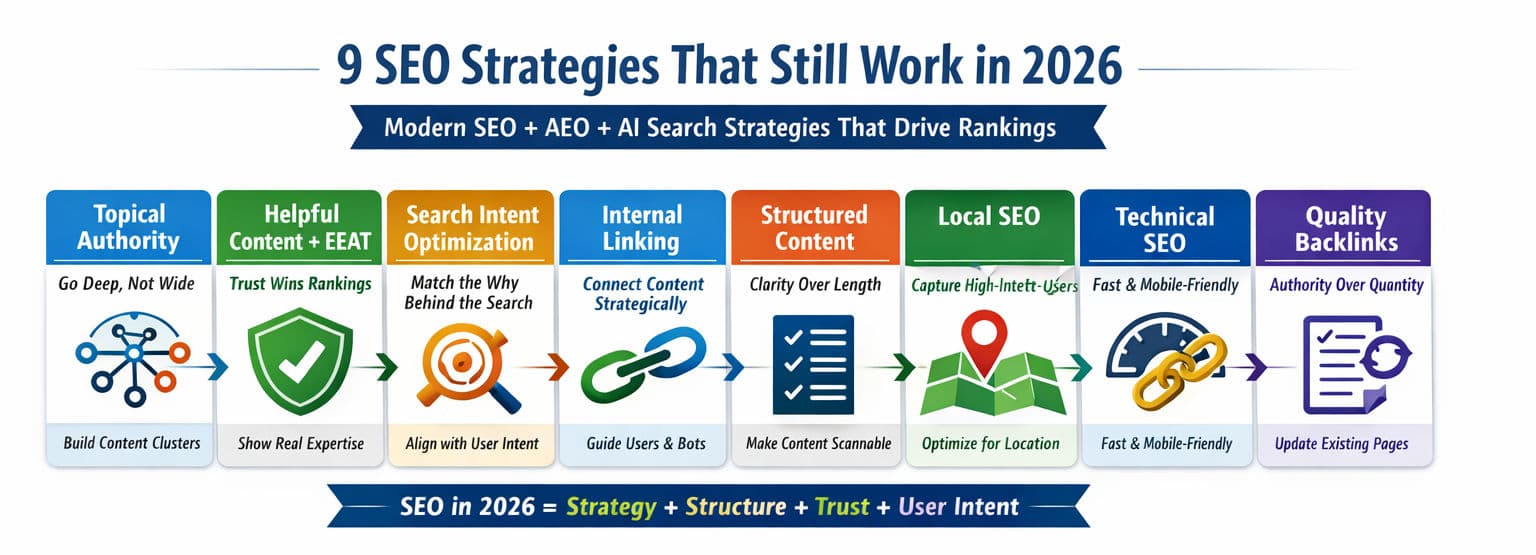
9 SEO Strategies That Still Work in 2026
Strategy #1 — Topical Authority Still Beats Random Blogging
Publishing random blogs is no longer enough to rank.
In 2026, search engines look for websites that demonstrate depth in a specific subject, not just surface-level content across multiple topics.
Topical authority means covering a subject completely, from basic concepts to advanced insights, through interconnected content.
Instead of writing isolated blogs, businesses need to build content clusters where each page supports another.
This helps search engines understand that your website is a reliable source in that domain.
For modern businesses, this is critical not just for SEO but also for AEO and AI-driven search.
When AI tools generate answers, they prioritize sources that show consistency and depth.
A website with structured content around a niche is far more likely to be referenced than one publishing scattered articles.
Strategy #2 — Helpful Content + EEAT Is Non-Negotiable
Content today is evaluated beyond keywords. Search engines now focus on whether the content is genuinely useful, accurate, and created by someone with real understanding.
EEAT: Experience, Expertise, Authoritativeness, and Trust, plays a major role in rankings. Businesses need to create content that reflects real-world knowledge, not just rewritten information.
Generic content is easy for AI to generate, but what ranks is content that adds value through clarity, examples, and relevance.
This is where many companies struggle. They produce content, but it does not help the user take action or understand the topic better.
In contrast, helpful content answers real questions clearly and directly, which also improves visibility in AI-generated search results.
Strategy #3 — Search Intent Optimization Wins Rankings
Keyword targeting alone is no longer enough. In 2026, understanding why a user is searching matters more than what they are searching.
Search intent can be informational, transactional, or navigational. If your content does not match that intent, it will not rank, even if it is well-written.
For example, a user searching for “SEO strategies 2026” expects insights and actionable ideas, not a sales pitch.
Modern SEO requires structuring content in a way that directly answers user queries. This is also essential for AEO, where content needs to be clear enough for search engines and AI tools to extract answers easily.
Strategy #4 — Internal Linking Is More Important Than Ever
Internal linking is no longer just a supporting tactic, it is a core ranking factor. It helps search engines understand the relationship between pages and distributes authority across your website.
A strong internal linking structure improves crawlability, increases time on site, and guides users toward relevant content. It also strengthens topical authority by connecting related pages into a meaningful structure.
For businesses investing in long-term growth, this is where professional SEO services play a critical role. A well-planned internal linking strategy ensures that every piece of content contributes to overall visibility, rather than existing in isolation.
Strategy #5 — Long-Form Content Still Ranks (If Structured Correctly)
Long-form content continues to perform well, but only when it is easy to read and properly structured. Simply writing 1500+ words is not enough.
In 2026, content needs to be:
- Scannable
- Logically structured
- Broken into sections
- Easy to navigate
Search engines prefer content that is comprehensive but also user-friendly. This is especially important for AI-driven results, where structured content is easier to extract and summarize.
Businesses should focus on clarity, not length. A well-structured article that answers multiple related questions will always outperform a long but unorganized page.
Strategy #6 — Local SEO Is Stronger Than Ever
Local SEO has become more important as users increasingly search for services “near me” or within specific locations. Google prioritizes businesses that are relevant, trustworthy, and locally optimized.
For companies operating in competitive markets, local SEO helps attract high-intent users who are ready to take action. Optimizing Google Business profiles, building local citations, and creating location-based content are essential steps.
From an AEO perspective, local queries are often answered directly within search results. Businesses that optimize for local intent have a higher chance of appearing in these featured answers.
Strategy #7 — Technical SEO Still Matters
No matter how good your content is, technical issues can prevent it from ranking. Website speed, mobile responsiveness, clean structure, and proper indexing are critical factors.
Search engines prioritize websites that offer a smooth user experience. Pages that load slowly or are difficult to navigate are less likely to rank, even if the content is strong.
Technical SEO also plays a role in GEO (AI search). AI systems prefer websites that are structured, fast, and easy to crawl, as this makes data extraction more reliable.
Strategy #8 — Backlinks Still Work (But Only Quality Links)
Backlinks are still a strong ranking factor, but the focus has shifted from quantity to quality. A few relevant, high-authority links are far more valuable than hundreds of low-quality ones.
Search engines evaluate backlinks based on relevance, credibility, and context. Links from trusted sources signal authority, while spammy links can harm rankings.
For modern businesses, this means focusing on building relationships, earning mentions, and creating content worth linking to, rather than relying on shortcuts.
Strategy #9 — Updating Old Content Gives Faster Results Than Creating New Content
One of the most overlooked strategies is updating existing content. In many cases, improving an old page can deliver faster results than publishing a new one.
Updating content helps:
- Improve relevance
- Align with current search intent
- Refresh outdated information
- Strengthen rankings
Search engines prefer fresh, accurate content. Instead of constantly creating new blogs, businesses should audit existing pages and optimize them based on current SEO trends.
This approach is also highly effective for AI visibility, as updated content is more likely to be considered reliable and relevant.
Strategic Takeaway
SEO in 2026 is not about doing more, it is about doing the right things consistently. Businesses that focus on structured content, user intent, and long-term strategy will continue to see results, while those relying on outdated methods will struggle.
5 SEO Strategies That No Longer Work in 2026
Outdated #1 — Keyword Stuffing
There was a time when repeating a keyword multiple times could help a page rank. That no longer works.
In 2026, search engines understand context, meaning, and user intent. Overusing keywords not only reduces readability but can also signal low-quality content. Instead of improving rankings, it can actually hurt performance.
Modern SEO focuses on natural language, topic relevance, and clarity. Content should read like it is written for a human, not optimized for a machine.
This is even more important for AEO and AI search, where clear and natural answers are prioritized over forced keyword placement.
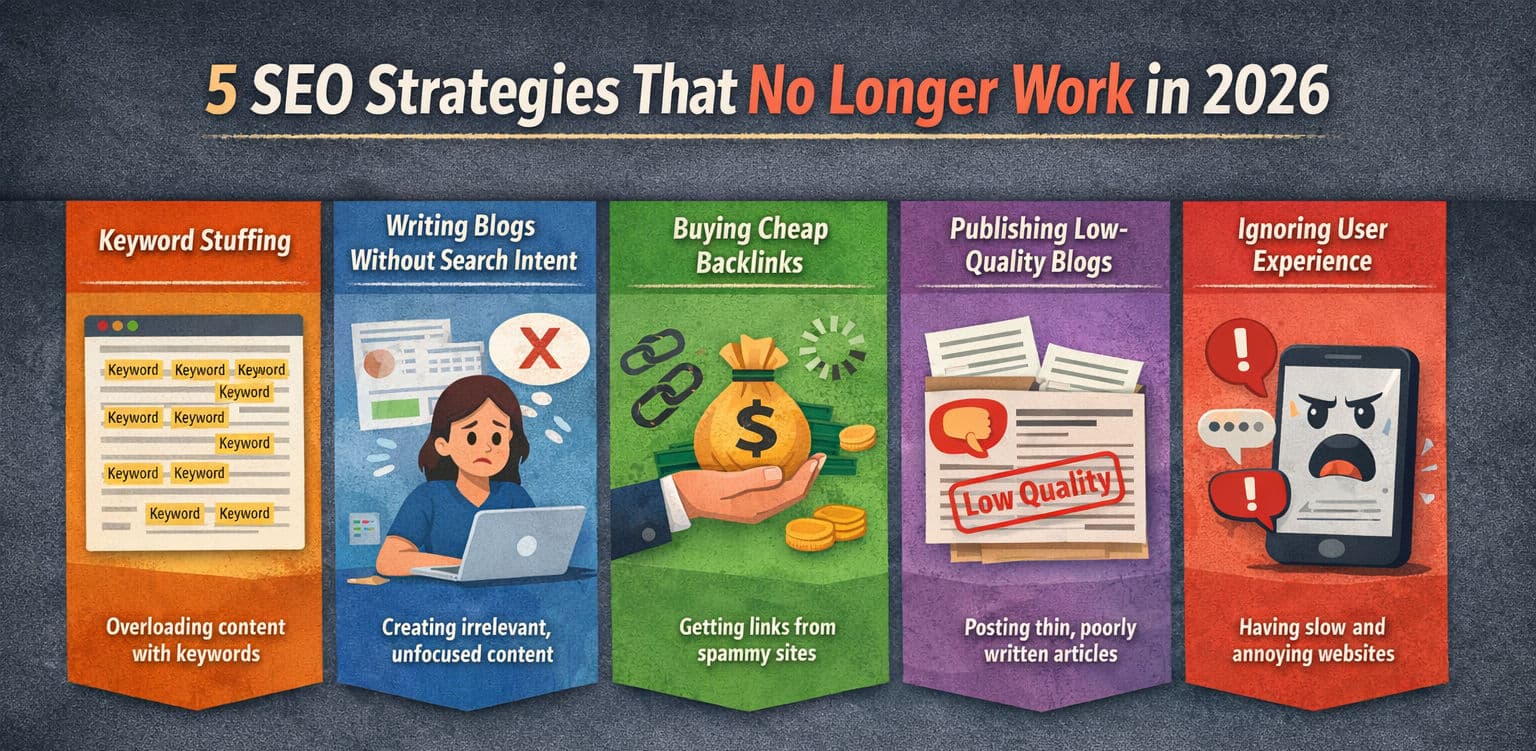
Outdated #2 — Writing Content Without Search Intent
Many businesses still create content based on what they want to say instead of what users are searching for. This disconnect is one of the biggest reasons content fails to rank.
If the intent behind a search query is not addressed clearly, the content will not perform, regardless of how well it is written. For example, a user looking for solutions does not want a general explanation, and someone researching does not want a sales pitch.
In modern SEO, every piece of content must align with a specific intent. This is also critical for AEO, where search engines extract direct answers. Content that does not match intent is simply ignored.
Outdated #3 — Buying Cheap or Spam Backlinks
Building large numbers of low-quality backlinks used to be a shortcut to rankings. Today, it is one of the fastest ways to damage a website’s credibility.
Search engines have become highly effective at identifying unnatural link patterns. Links from irrelevant or spammy websites do not add value and can lead to penalties or reduced visibility.
In 2026, backlinks need to be earned, not bought. Relevance, authority, and context matter more than volume. Businesses that focus on genuine link-building strategies see long-term results, while shortcuts rarely work anymore.
Outdated #4 — Publishing High Volume, Low-Quality Content
More content does not mean better results. Many businesses still believe that publishing frequently will improve rankings, but this approach often leads to the opposite outcome.
Search engines now prioritize quality over quantity. Large volumes of thin or repetitive content dilute website authority and reduce overall performance. Instead of ranking multiple pages, none of them perform well.
From an AI and GEO perspective, low-quality content is rarely referenced or surfaced in results. What matters is depth, clarity, and usefulness, not how many blogs are published.
Outdated #5 — Ignoring User Experience and Page Quality
SEO is no longer limited to content and keywords. User experience plays a major role in how pages are ranked.
Websites that are slow, difficult to navigate, or poorly structured struggle to retain users. High bounce rates and low engagement signal to search engines that the page is not valuable.
Modern SEO requires a balance between content and experience. Pages need to load quickly, be mobile-friendly, and present information clearly. This is especially important for AI-driven results, where structured and user-friendly pages are easier to process and recommend.
Strategic Contrast
The difference between what works and what doesn’t in 2026 is clear. SEO is no longer about shortcuts, volume, or manipulation. It is about:
- Relevance
- Clarity
- Structure
- Consistency
- Real value
Businesses that continue to rely on outdated practices will struggle to see results, while those that adapt to modern SEO, AEO, and AI-driven search will continue to grow.
Why Most Businesses Still Use Outdated SEO Methods
If SEO has evolved so much, why are businesses still following outdated strategies?
The main reason is familiarity. Many companies continue to rely on methods that worked in the past because they are comfortable and easy to execute. Keyword stuffing, bulk content publishing, and low-cost link building are still widely used simply because they require less strategic thinking.
Another reason is misinformation. SEO advice online is often outdated or oversimplified. Businesses follow generic checklists without understanding how search engines actually work today. As a result, they invest time and money into activities that do not produce results.
There is also a gap between execution and strategy. Many teams focus on doing SEO tasks rather than building a structured approach. Without a clear plan, even good efforts fail to deliver consistent growth.
Finally, some businesses expect quick results. Modern SEO is a long-term process, but outdated tactics promise faster outcomes. This creates a false sense of progress in the beginning, followed by a drop in performance over time.
The reality is simple, SEO has not stopped working. The approach has changed. Businesses that continue to use old methods are not failing because of SEO, but because of the strategy behind it.
How to Build an SEO Strategy That Works in 2026
Building an effective SEO strategy today requires more than just content creation or keyword targeting. It requires a structured approach aligned with how search engines and users behave.
Start by understanding your audience and their search intent. Every piece of content should solve a specific problem or answer a clear question. This ensures relevance, which is the foundation of modern SEO and AEO.
Next, focus on building topical authority. Instead of publishing random blogs, create clusters of related content that cover a subject in depth. This helps search engines recognize your website as a reliable source in that area.
Content should be helpful, clear, and easy to navigate. Structure matters, use headings, logical flow, and simple language so both users and AI systems can understand the content easily.
Technical performance cannot be ignored. A fast, mobile-friendly, and well-structured website improves both rankings and user experience. Without this foundation, even high-quality content may struggle to perform.
Internal linking should connect all relevant pages to guide users and strengthen authority. This ensures that your content works together rather than competing with itself.
Most importantly, SEO should be treated as an ongoing process. Regular updates, performance tracking, and content improvements are necessary to stay aligned with changing algorithms.
Businesses looking to implement this effectively often need a clear and structured SEO strategy for business growth, especially when scaling beyond basic optimization into long-term visibility.
SEO in 2026: What Actually Drives Long-Term Growth
SEO success today is not driven by shortcuts or isolated efforts. It is built on consistency, clarity, and alignment with how search engines deliver results.
Long-term growth comes from creating content that genuinely helps users, maintaining technical quality, and continuously improving existing pages. Websites that focus on these fundamentals build trust, both with users and search engines.
AI-driven search and generative results are also shaping the future of SEO. Content that is structured, reliable, and easy to interpret has a higher chance of being surfaced in these environments. This makes clarity and depth more important than ever.
Another key factor is adaptability. SEO will continue to evolve, and strategies that work today may change in the future. Businesses that monitor trends and refine their approach consistently are the ones that stay ahead.
Ultimately, SEO in 2026 is not about chasing rankings. It is about building a strong digital presence that attracts, engages, and converts the right audience over time.
When done right, SEO becomes one of the most sustainable channels for business growth, not just in search rankings, but in long-term brand visibility and credibility.
SEO Still Works in 2026 — But Only If Done Right
SEO has not become less effective, it has become more refined.
What worked earlier was often based on shortcuts, volume, and basic optimization. Today, SEO is driven by relevance, intent, structure, and trust. Businesses that adapt to these changes continue to grow steadily, while those relying on outdated methods struggle to see results.
The difference is not effort, it is direction.
Modern SEO requires a clear strategy, consistent execution, and a focus on delivering real value to users. It is no longer about ranking for keywords alone, but about building a presence that search engines and AI systems recognize as reliable.
As search continues to evolve with AI and generative results, the focus will remain the same, helping users find accurate, useful, and trustworthy information.
Businesses that align with this approach will not just rank better, but build long-term visibility and credibility.
Frequently Asked Questions (FAQs)
Yes, SEO is still one of the most effective digital marketing strategies. However, the approach has changed. Success now depends on content quality, user intent, and overall website experience rather than just keywords and backlinks.
The biggest shift is the move toward intent-based and AI-driven search. Search engines now focus on understanding user queries and delivering the most relevant and helpful results, not just matching keywords.
AEO (Answer Engine Optimization) focuses on structuring content so it can be directly picked up by search engines and AI tools as answers. This improves visibility in featured snippets and AI-generated results.
GEO (Generative Engine Optimization) refers to optimizing content for AI-driven search platforms. It involves creating clear, structured, and trustworthy content that AI systems can easily interpret and present.
SEO is a long-term strategy. Depending on competition and consistency, it can take a few months to start seeing results. However, once established, it delivers sustainable growth.
Yes, content remains a core part of SEO. But it must be helpful, relevant, and well-structured. Simply publishing content without strategy will not produce results.
Both are connected. SEO now includes optimizing for AI search. Businesses should focus on creating content that works for both traditional search engines and AI-driven platforms.
The most effective approach combines: • strong content • clear intent targeting • technical optimization • internal linking • continuous updates SEO today is about building a complete system, not isolated efforts.